The Technology Readiness Level (TRL) scale was developed during the 1970s and 1980s. The National Aeronautics and Space Administration (NASA) introduced the scale as a discipline-independent program figure of merit (FOM) to allow more effective assessment of, and communication regarding, the maturity of new technologies. Later, it was generalized to apply to any project, not only aeronautical or space projects, from its original idea until its deployment. Yet, there is increased use of the Technology Readiness Levels (TRL) scale as a planning tool for innovation management. As with every tool, the TRL scale has its strengths as well as its clear limitations. Although it is a standardized scale, different definitions may be found depending on the technology being assessed.
In this article, we are trying to understand the basics of the TRL scale as applied to a systematic definition for hardware and systems technologies. In future posts, we will do the same with software, pharmaceutical developments, and medical devices, compared with the applied technology (NASA TRL scale).
Research activities belong to the first scale, TRL 1–4.
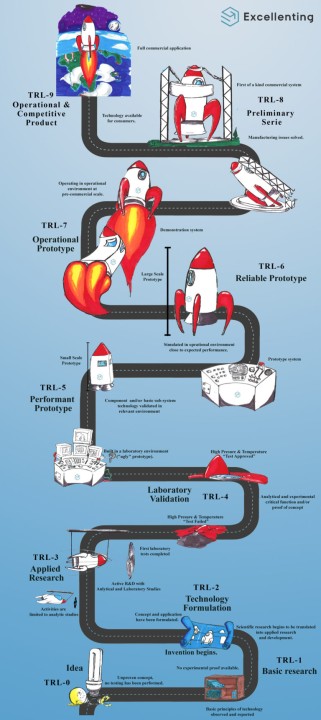
As with every invention, the bottom of the scale corresponds to scientific research translated into applied R&D activity, with studies of basic properties documented in papers (TRL 1). The resulting applications are mainly speculative, with no proof of concept to support assumptions. At this level, the technology is limited to analytical studies (TRL 2). The next step involves active R&D activities, including analytical and laboratory studies to physically validate previous analytical predictions and assumptions. Although some components are not yet integrated, this is considered the first proof of concept (TRL 3). The resulting system integrates basic technological components that work together with low fidelity compared with the eventual system. This «ugly prototype» or «pre-prototype» includes the integration of ad hoc hardware in a laboratory environment (TRL 4). All these actions and events are considered research activities.
Prototyping is considered a development activity, TRL 5–7.
Development activities start with the integration of components with reasonable and realistic supporting elements for testing in a simulated environment. High-fidelity integration is achieved at the laboratory level (TRL 5). At this stage, the technology is tested in a relevant environment. It starts to be considered a representative prototype, to be tested in a high-fidelity laboratory or simulated operational environment (TRL 6). Testing is then moved to operational environments, such as a vehicle or machinery. This is the first fully approved prototype (TRL 7).
Innovation is limited to the last two TRL levels, TRL 8–9.
The last two levels are related to innovation activities, where the technology is proven to work in its final form and under expected operational conditions. Tests and evaluation of the system are carried out in its intended or pre-production configuration. Design specifications, including quality and safety conditions, along with operational suitability, are evaluated. At this stage, pre-series manufacturing is intended to overcome any future mass-production issues (TRL 8). Finally, the technology is shaped for its actual application, meets production configuration, and operates under real conditions such as those identified during operational tests and evaluation (TRL 9).